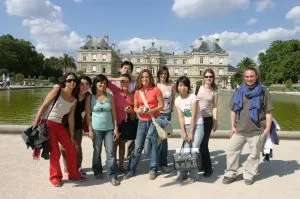
Secondary School in France

This selective programme gives young students the opportunity to discover France, its way of life and its culture, while improving language skills and growing as individuals.  Ideal for Transition Year students, it is available throughout the academic year. Students assume the life of an everyday French teenager; they will live with a carefully selected host family, attend a local French secondary school and experience the life, culture and language of France through complete immersion.  Available for a minimum of 6 weeks up to the full academic year, this is the best way to experience the French way of life, achieve fluency and become more independent and mature young adults.

Lazzuly AineFe: A student and her host sister.

Host families

All French host families are sourced, vetted and screened through our French partner organization based in St. Malo.  They have a team of local coordinators based throughout France who live in the local area.  After an interview and home visit, host families are carefully selected by the local coordinator  according to very definite selection criteria: open-mindedness, availability, receptiveness, good sense of welcoming and good accommodation conditions.  Placements are always in safe residential areas that guarantee good conditions.  Placements are mostly made in rural areas (countryside) and medium-sized towns, and very rarely are in the centre of big towns.  Students can be placed in any region in France, so they must have an open mind to this when applying.  There is no guarantee of geographical preference in the placement process.  Families are volunteers and receive no allowance for hosting international students.  This concept of host family payment is unique to Ireland and Britain.  Therefore, the motivation to host international students is not money-driven; host families have a genuine interest in learning about the countries of their students and exposing themselves and their children to another culture by hosting.  Some families hold the belief that hosting a student from Ireland is the next best thing to visiting Ireland itself.  Students are truly considered a member of the family, equal in rights and duties, and they share the day-to-day life, including leisure and outings.  In return, they are asked to comply with family rules, which might include some minor tasks like washing the dishes or cleaning their bedroom.  The host family is seen as responsible for the students' welfare and our partner office, CEI, insists on their role as "parents".  Host families come in all shapes and sizes; single parents, nuclear families, older couples whose children are no longer at home, as well as young couples who may not have children, are all considered potential host families.  Our main criteria is a warm, caring, and comfortable home environment for students to be nurtured and thrive in.

School

The French school (Lycee) is chosen jointly by the family and the local coordinator; generally speaking this is the same school as the children of the host family, but the students' academic records are also taken into account in the choice. The local representative will consult with the Lycée officials in order to place the candidates in the school and grade best suited to their background and needs. Lycée placements will also depend upon the particular schools available in the homestay area. Sometimes, the option of attending the local college in 3ème classe (the last class of the college before entering in high school) is the best suitable placement, considering the host family, academic records and age of the participant. Students may be placed in a class lower than their Irish equavalent considering their language ability and community.

There are 3 trimesters (3 month grading periods) per school year, starting in September (official national date). School holiday dates vary according to the placement area. In general, French schools have a holiday or break over 6 or 7 weeks. This website has additional information for each "zone" in France.

Most French state schools are now working to the four-day week with Wednesday remaining free and no school on Saturdays but it depends on the lycée. Students can go to school on Wednesday and/or Saturday mornings.

The average school day in France:
A school day in France is long. There is a 1½ to 2-hour lunch break as the day ends at 5:00PM and sometimes 6:00. The actual start and finish times will vary according to each local school. A time-table will be provided by the school and should be checked with the school after arrival.

In general, French students study hard and put less of an emphasis on extra curricular activities than their Irish counterparts. French high schools do not usually offer extra-curricular activities (sports on Wednesday afternoons or theater, music clubs between 12 and 2 pm). School is very demanding, days are long and students are assigned a lot of homework, so sports and cultural activities are not connected to the school. Such activities take place outside of school. Sports clubs, art schools and youth groups offer extra curricular activities for high school students. Sports and activities will vary region to region. Students should view this programme as a different experience to what they are used to and may have to put sports and hobbies on hold if they are not available in their host community.

There are three grade levels in the French high school (lycée):

  • Classe de Seconde (15-16 y. old). Required subjects in this level are: French literature, two foreign languages, history and geography, maths, physics and chemistry, biology, economics. Most Transition Year students will be placed in Class de Seconde. In some cases, TY students who struggle with their French maybe placed in a Collège in Classe de Troisième, which is the final year before French students enter High School, or Lycee.
  • Classe de Première (16-17 y. old): In this level, students must choose classes from one of the following sections: Literature, Economics, or Sciences
  • Classe de Terminale (17-18 y. old): In this level, students are focused on taking the baccalureat test and spend a lot of time in study hall preparing their subjects of specialisation (literature, economics or sciences).

Transportation

Airport transfers are included from Paris Roissy/Charles de Gaulle Airport on arrival and departure.  Flights are not included in the programme price.  EIL will confirm with parents as soon as possible about what dates and times the student must arrive and depart (it is always on a Friday).  Once the flights are booked, CEI will organise the student's transfer to the host community by train.  A CEI representative will meet the student on arrival, will have the train ticket booked and will escort him or her to the train platform.  Students will travel independently or with other arriving international students by train and will be met on the other side by the host family or local coordinator.

Local transportation to and from school is however the host family sees fit.  Depending on the community, students may be able to walk or cycle, may be driven or carpooled or required to take the bus.  In the case of a school bus, students will need to pay for their own costs, if necessary.

Important conditions

Friends will not be placed together.  This is a programme designed for independent and individual students.  Emphasis is on full language and cultural immersion.  If friend apply together, they will be intentionally separated and placed in different communities and schools.

Students may not return home for the duration of their programme.  This includes Christmas and Easter holidays.  All family visits should be limited to the end of the student's programme, not at the beginning or in the middle.  After years of experience, we find that such visits disrupt the adjustment process and can lead to further homesickness and integration problems.

Students and parents cannot "reject" a host family placement in favour of a new one.  Once host family details are sent to the student, they are final.  Cancellations will incur loss of deposit.

EIL and CEI reserve the right to send home any student whose health requires it or whose conduct is considered improper or offensive to the host family, community or school.  Such conduct includes drug use, unacceptable sexual behaviour, excessive drinking, violation of the law or failure in schoolwork.  In the event that the student is returned home, either alone or accompanied, parents or guardians are responsible for all expenses above those covered by the fee.  In such cases no refunds will be available. If a student chooses to end the programme early on his or her own accord, no refunds are available.

Further conditions of participation are included in the application forms.

FAQ

Questions

Answers

  • Can students request to be placed in private schools or boarding?

    No, the best school for the students are chosen according to availability, the host family, geographical and quality parameters.

    Back to the top

  • Can you offer placements in specific types of schools, e.g. music focus, science focus, sports available, equestrian, etc?

    No, as these types of school are very selective high schools, not necessarily open to foreign exchange students

    Back to the top

  • Are students ever placed in single sex schools, or religious denominational schools?

    No. All French schools are mixed. Private schools follow catholic values but are non-practicant.

    Back to the top

  • What are some typical clubs that students would be able to join?

    Many sports and music clubs are available (soccer, rugby, tennis, athletics are the most practised disciplines).

    Back to the top

  • Do teachers grade exchange students on the same level as their French classmates?

    No, and usually not at the beginning when the level of French is too weak.

    Back to the top

  • Do students generally receive a formal transcript?

    Yes, but mainly for full semester or academic year students, but the student is in charge of getting the transcripts before leaving the program. Shortterm (6, 8, 12 weeks) students may not have had enough assessment to get official marks.

    Back to the top

  • Will I host a French student in return?

    No, this is a one-way exchange. You will not have to host a French student. Some Irish students remain friends with the host family and siblings and stay in contact, but there is no obligation to have them come to Ireland unless you made a personal arrangement amongst yourselves.

    Back to the top

  • What do the fees pay for?

    Administration costs for the hosting (CEI) and sending organizations (EIL), interview, orientation material, insurance with Caremed, support from a local coordinator and EIL Ireland, school enrolment fees, and transfer costs. EIL and CEI are both not-for-profit exchange organizations.

    Back to the top

  • What other costs are expected during the programme?

    School transport (from €0 up to €70 for year on average), books, school stationary, an additional €200-250 may be needed for school start-up expenses and personal expenses such as phone, Internet, hygiene products, clothes, entertainment, etc. Recommended spending amount: €130-180 per month.

    Back to the top

Dates/Prices


2010/2011 Academic School Year prices

Length Price
6 weeks €2455
2 months €3001
3 months €3325
4 months €3641
6 months €4424
10 months €6077
11 months €6593

Deadline for Autumn start applications is May 1st.
Deadline for January start application is October 1st.
Late applications will be considered on a case-by-case basis.

All other mid-term applications are due no later than 6 weeks prior to requested departure. Dates are flexible for mid-term applications and are accepted on a rolling admission basis. If you indicate the dates you available from and the duration, we will try to find you a placement that suits. April is the last month in the year to commence a 6 week programme.

Please note that applications for the mid and final terms of the 2009/2010 academic year are still being taken.  Students will be charged the fees for the 2009/2010 year.  Please contact us for details.

Apply

PDF application form for CEI/EIL - completed in full. Student portion should be completed by the student in French, unaided.

€500 deposit for short-term application. For Semester or Year programmes, 25% of the programme price.

Applications must include:

  • 6 passport photos
  • Copies of school reports for the last 2 years and current reports if available.
  • Immunization record with Medical report
  • All signatures requested of student, parents, teacher/school, GP must be completed. Please read carefully and complete neatly.

Please note that deposit and application receipt does not mean the student is automatically accepted. After EIL and CEI inspect and review the application and conduct an interview will you get notification of acceptance or not. In cases where students is not accepted for whatever reason, your deposit will be refunded. EIL and CEI reserve the right to reject any application.

Applications must be received at least 6 weeks in advance.  Failure to include or complete any part of the application will delay your acceptance and may result in missing the deadlines.

Blogs/Photos

Photos: 
Stories: 

Currently there are no reports to display for this section, please check back soon as we're updating them as we receive accounts from our participants constantly.